
A website you walk through, with a 3D science guide inside
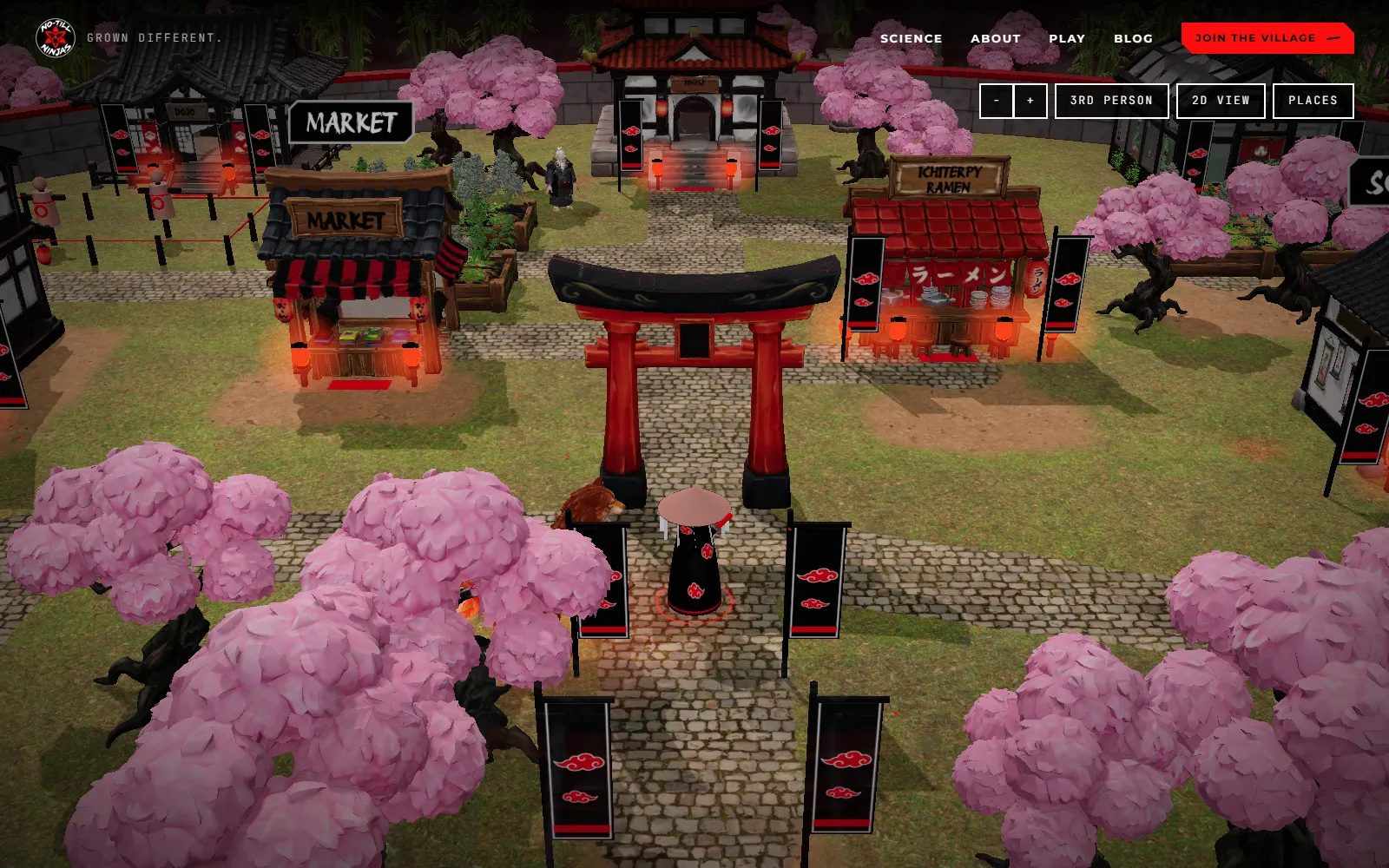
The home page of our own grow brand is a 3D village you explore as a ninja. Every building is a page. Walk into the Soil Lab and a four-chapter science guide opens, each chapter a 3D scene that moves as you scroll. There is an arcade out front.
Why build it this way
No-Till Ninjas is our own brand: a home grow run in living soil, never tilled. It is the place we try the ideas we want to offer clients before a client pays for them. The question was simple. What would a website look like if the menu were a place instead of a list?
The village
The home page is a small 3D village with cherry trees, a ramen shop and a gate to walk through. There is no menu bar to read. You tap anywhere and the ninja walks there; walk up to a door and you go in.
- Every building is a page. The Dojo opens the full site, the Soil Lab opens the science guide, the Scroll Library holds the writing, and the arcade cabinets out front open the games. At the market stall you browse the merch without leaving the village.
- It works with a thumb or a keyboard. Tap to walk on a phone; walk, jump and throw with the keyboard on a computer.
- Stop for ramen. Sit on a stool at the ramen counter and order a bowl. Each one powers the ninja up for 90 seconds: run faster, jump higher, or recharge his moves sooner. The menu says what each bowl does.
- Climb the lookout. A stone deck on the cliff above the village looks out over the whole place, and you can walk out onto it.
- Switch to third person. On a computer, the camera can drop in behind the ninja’s shoulder, with mouse look and a crosshair.
- Nobody gets a broken page. A device without 3D support gets a 2D view of the same village, and a Places button lists every page for anyone who would rather not walk.
The science guide
The Soil Lab holds four chapters on what happens under a no-till bed: how fungi trade with roots, the soil food web, cover crops pulling nitrogen out of the air, and what a single pass of a tiller does to all of it.
- Each chapter is a 3D scene, driven by scroll. As you scroll, the camera moves through the soil: hyphae growing out to minerals, nematodes and mites working the food web, clover roots with their nodules. The last chapter puts two slabs side by side. A tiller crushes the crumbs and cuts the fungal network on one; the other keeps its pores, its network and its worm channel.
- Labels are pinned to the 3D. Field-guide callouts track the exact point they describe as the camera moves.
- Built to stay fast. A scene loads only when its chapter is near the screen and unloads when it is far away, so only one or two run at a time. Phones get a lighter version. Anyone with reduced motion turned on, or without 3D support, gets detailed 2D field-guide plates instead.
The arcade
Three small games run in the browser, no download: Defend the Dojo, where you swipe to slice pests out of the air before they land on the plants and spare the ladybugs; Dojo Guardian, a top-down game with a touch joystick on phones; and Ninja Duel. They exist for the same reason the village does. People stay, and people send them to a friend.
Why it matters for your business
Most businesses do not need a village. What carries over is the approach: find the one thing about your business that is interesting in real life, and make the website do that instead of describing it. For a coffee bar in a hatchback, the hatch opens as you scroll. The tools behind the login of this site are their own project; see the amendment calculator.

Next project DDD Coffee: A coffee bar in the hatch of a Civic Type R, and a website that opens the hatch
Let’s build something that pays for itself
A free 15-minute call. We look at your site, your listing, and where your hours go, then tell you what we would do first. No deck, no pressure.
Or email info@trichomedigital.com